The Chair Migration: How a Common University Workaround Inspired a Patented EdTech Solution
How a routine infrastructural breakdown across Kenyan lecture halls exposed a hidden data mismatch—and birthed a new standard for campus operational predictability.

Machi
Founder, Tamari
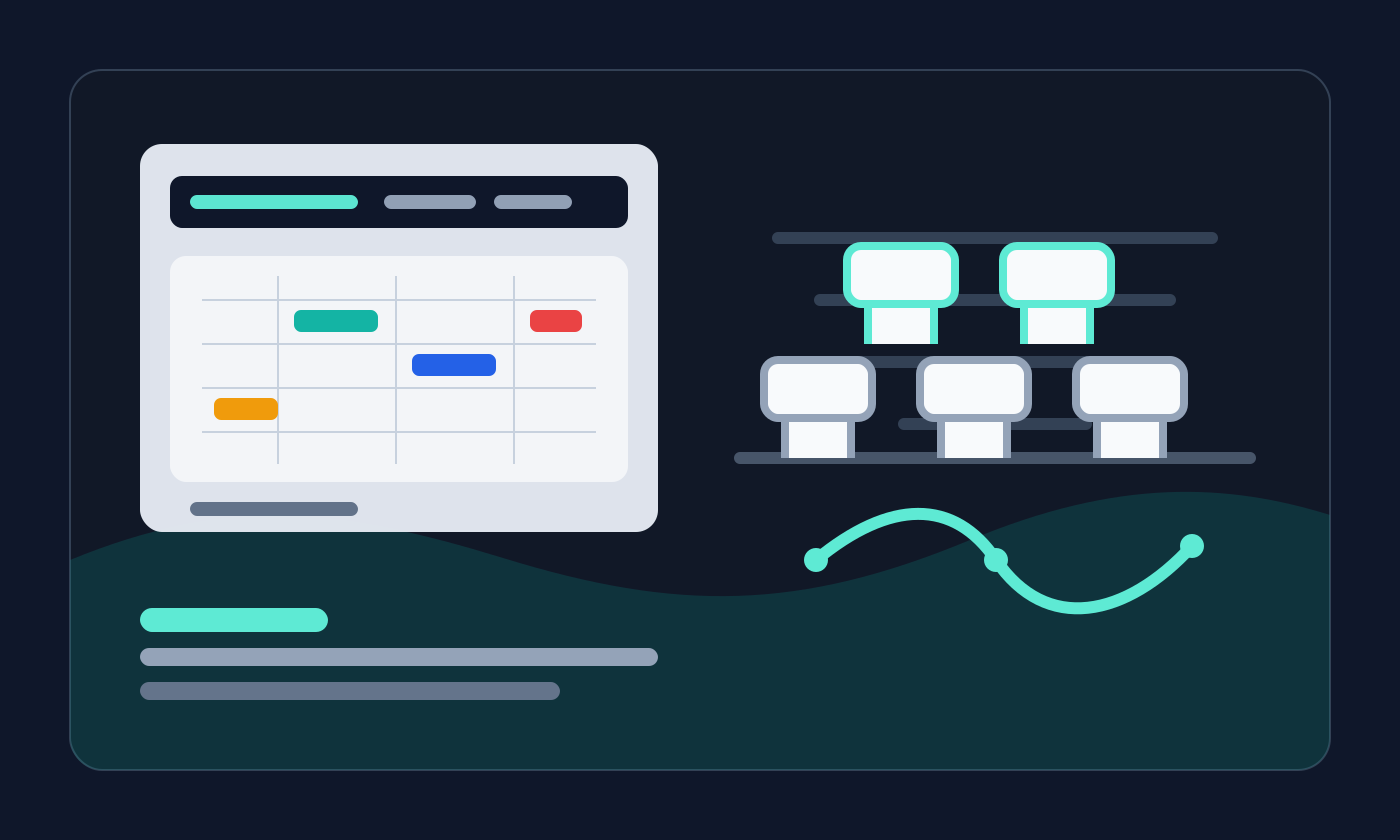
If you have ever stepped foot on a public university campus in Kenya, you have witnessed a strange, quiet ritual.
A lecture is about to start. Students stream into the hall, only to realize the room is already at capacity. Within minutes, a silent coordination begins. One student slips out and returns carrying a wooden chair from a neighboring room. Then another does it. Then three more.
Before long, chairs are migrating across hallways, between floors, and sometimes across entire campus buildings.
It is a phenomenon so deeply embedded in the fabric of campus life that most people don’t even notice it anymore. It is accepted as "just the way things are."
But when you stop treating it as a normal part of the student experience and start looking at it through the lens of operations, a deeper question emerges: Why are students carrying chairs in the first place?
The Hidden Scheduling Blind Spot
At first glance, the “chair migration” looks like a simple infrastructure issue—a lack of furniture. But a closer look reveals that it isn’t a furniture problem at all. It is a data and scheduling problem.
When a university plans its semester, the original timetable is usually crafted with immense care. Timetablers manually match estimated student enrollment numbers against room capacities to ensure a perfect fit. On paper, the system works.
The breakdown happens when real life intersects with a rigid system.
Throughout the semester, schedule disruptions are inevitable. Professors have emergencies, holidays shift dates, and impromptu makeup lessons must be scheduled. Unlike the original timetable, these reactive changes rarely get the same rigorous capacity considerations. Because administrative teams lack real-time visibility into actual, live classroom usage at any given hour, makeup classes are often booked blindly into random, available slots.
When a class of 150 students is scheduled into a room designed for 60, a chaotic ripple effect is triggered. Capacity is breached, students are forced to forage for chairs from neighboring rooms, and the next scheduled class in those rooms inherits a shortage.
Operational flaws rarely announce themselves out loud. Instead, they hide quietly inside the manual workarounds that human beings normalize to keep things moving.
Enter Tamari: Bringing Predictability to Higher Ed
As a student at Masinde Muliro University of Science and Technology (MMUST), I watched this loop repeat semester after semester. But instead of accepting the workaround, I saw an opportunity to treat the entire campus as a dynamic network optimization challenge.
That insight became the foundation for Tamari.
Tamari was built to bridge the gap between static planning and real-time campus operations. Rather than treating a university timetable as a rigid document printed at the start of the semester, Tamari treats it as a living, dynamic ecosystem.
We designed a scheduling system specifically tailored for higher learning institutions. By introducing real-time visibility into classroom operations, Tamari ensures that when the inevitable cancellations, room reallocations, and makeup lessons happen, they are handled with the exact same data-driven care as the original timetable.
No more blind bookings. No more capacity overruns. No more ripple effects.
From an Idea to a Registered Patent
What started as an observation on a walk between lecture halls has since evolved into a heavily researched, engineered, and officially patented system.
Following my graduation from MMUST, and with the incredible guidance and support of patent attorney Mr. Fred Otswong'o and the MMUST Innovation Academy, we successfully registered the patent for our dynamic timetable scheduling system.
Innovation doesn’t always require inventing a completely new concept from scratch. True innovation often begins by looking closely at a problem everyone else has stopped seeing and asking why.
The Future of Campus Operations
At Tamari, our mission is simple: to eliminate the invisible administrative friction that drains university resources and disrupts student learning. Higher education institutions are complex ecosystems, and managing them shouldn’t rely on human workarounds. They deserve modern, predictive, and intelligent tools.
We are building a future where campus operations run seamlessly in the background, allowing administrators to optimize space, lecturers to teach without friction, and students to focus on what truly matters—their education.
And safely leave the chairs where they belong.
Want to see how Tamari can transform scheduling, space utilization, and operational predictability at your institution? Book a demo with our team today.
Ready to modernize campus scheduling?
Book a Tamari demo
See how dynamic timetable scheduling improves coordination, reduces conflicts, and brings clarity to academic operations.
Book a Demo